NVIDIA's 800 VDC rollout gives data-centre operators several ways to move power conversion closer to the building entrance. Its August update puts an MGX-compatible power rack on the roadmap for the second half of 2026, followed by a row power centre in 2027. A facility-scale DC power block is the longer-term option for new builds. These are availability plans, rather than evidence that every configuration is shipping. NVIDIA's August roadmap
The useful planning question is where AC becomes DC, and which equipment has to change with it. Solid-state transformers address one part of that question: conversion from medium-voltage AC to the DC distribution system.
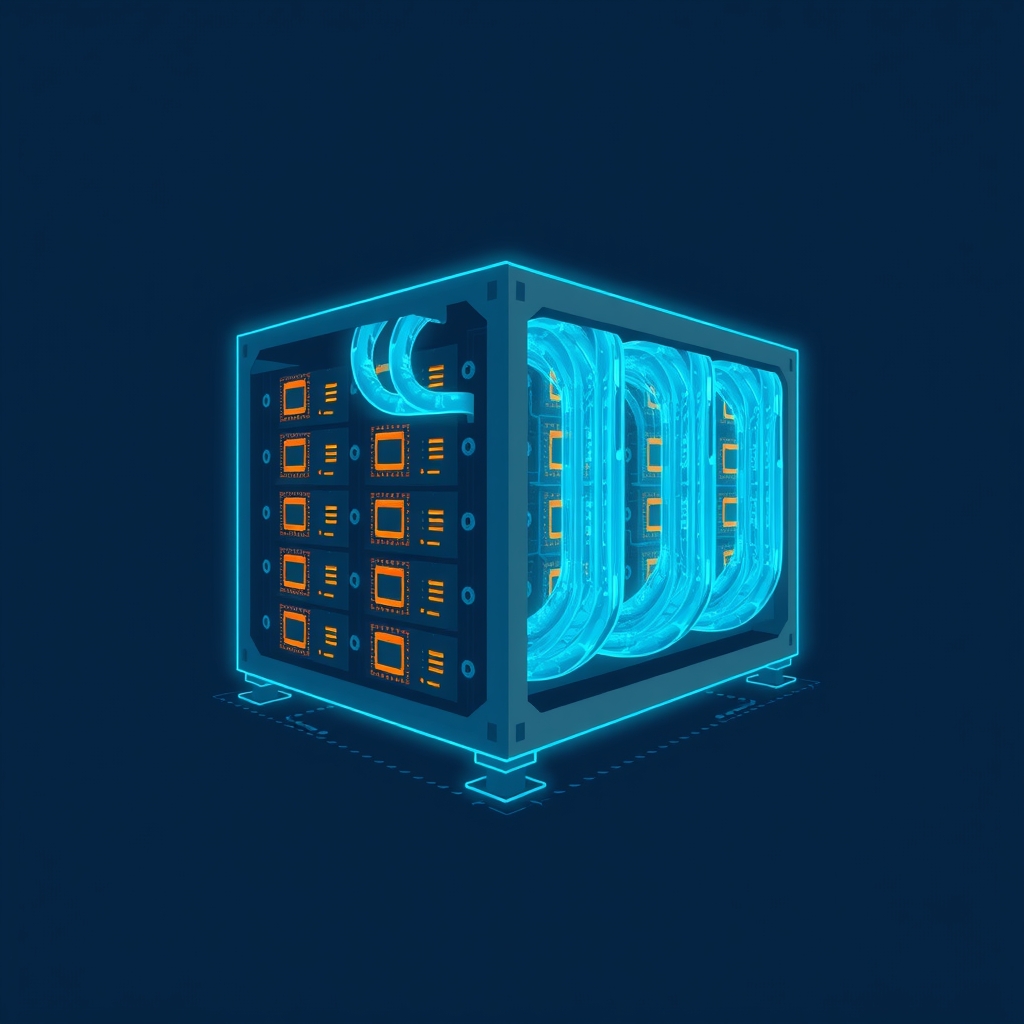
Cover: AI-generated conceptual illustration of electrical infrastructure, not a photograph or product diagram.
Three ways to introduce 800 VDC
| Architecture | Where conversion happens | Status in NVIDIA's August 2026 update |
|---|---|---|
| MGX-compatible power rack | Near the compute racks, using the existing AC infrastructure | Arrival planned for H2 2026 |
| Row power centre | A shared station feeding an overhead DC busway | Expected in 2027; up to 2 MW per row |
| DC power block | Facility-scale conversion from medium-voltage AC | Longer-term architecture for new facilities |
NVIDIA says the first option is designed to preserve the building's existing electrical system while supplying compute racks with 800 VDC. The row-level option centralizes that function. The power-block approach takes conversion further upstream. Roadmap and deployment options
Our reading: a procurement brief should identify the intended topology before asking for an “800 VDC-ready” quote. The same voltage label can describe substantially different equipment locations and project scopes.
Why distribution voltage matters
NVIDIA's May 2025 technical explanation identifies the space and conductor burden of extending 54 V rack distribution to megawatt-scale systems. It estimates that a 1 MW rack using that approach could require up to 200 kg of copper busbar. The proposed higher-voltage path still needs DC-to-DC conversion inside the compute rack; processors do not run directly from an 800 V rail. NVIDIA's architecture explanation
The basic DC calculation illustrates the pressure. Using current = power / voltage, and ignoring conversion losses, a 1 MW load draws approximately 18,519 A at 54 V or 1,250 A at 800 V. Those are calculated currents for the same hypothetical load, not measurements of a shipping rack.
Keep the comparison boundaries separate. In that technical post, NVIDIA's claimed 45% copper reduction belongs to its discussion of changing row distribution from 415 VAC to 800 VDC. It is not a measured 45% saving from the 54 V rack example. NVIDIA also claims up to a 5% end-to-end efficiency improvement; site-specific savings need a defined baseline and validation.
What a solid-state transformer does
OCP's SST specification v0.3 defines a medium-voltage solid-state transformer as a megawatt-scale power-electronic converter. The intended role combines medium-voltage conversion with DC output. When coupled with energy storage, the equipment could function as a medium-voltage uninterruptible power supply.
That makes the SST a building block within the power architecture. It does not make every rack-adjacent AC-to-DC power unit an SST, or establish a universal date when conventional transformers disappear.
The document is also still evolving. Section 5.2 leaves some distribution, redundancy and energy-management parameters to future definitions. Section 5.2.2 says detailed load-test profiles will arrive in future versions. Section 5.4 leaves grounding details for later revisions. A specification under active development is useful evidence of design direction; it should not be presented as a complete, settled installation rulebook.
Where onsemi fits
In its July 29, 2025 announcement, onsemi described collaboration with NVIDIA on 800 VDC and a silicon and silicon-carbide portfolio serving transformer, power-supply, distribution and processor-power applications. That wording supports a component-supply role. It does not establish that onsemi sells a complete NVIDIA facility power block.
A July 2026 technical update makes the distinction clearer. onsemi describes commercial SiC power modules for SST designs alongside 2.3 kV and 3.3 kV technologies still in development. It characterizes the SST market as entering early commercialization. For readers tracking suppliers, shipping components and developing higher-voltage devices are separate milestones from qualifying and delivering a complete system.
Higher voltage still needs energy storage
NVIDIA's October 2025 ecosystem discussion treats workload volatility as a separate engineering problem. Synchronized GPU computation and communication can produce rapid changes in facility demand. Raising distribution voltage helps move power, but does not by itself smooth those changes.
The company describes capacitors and supercapacitors near racks for short-duration fluctuations, with facility battery systems handling slower changes and supporting transitions to backup generation. This matters when comparing proposals: the converter rating, usable storage energy and control behaviour answer different questions. A megawatt figure alone does not state how long a system can support a load.
Open interfaces and the buying decision
In its August 11 update, OCP describes Google, Microsoft and NVIDIA working toward shared requirements for power quality, smoothing and interfaces. The stated aim is interoperable equipment with room for different implementations. The partners also report engagement with UL Solutions, NFPA, IEEE and IEC on certification and regulatory frameworks.
For an operator, our suggested next step is to ask suppliers for the precise interface revision, demonstrated load response, protection approach and delivery status behind a proposal. Treat the sidecar, row station and medium-voltage converter as individually specified purchases. A roadmap announcement cannot substitute for those answers.
For the current rack context, our GB300 power and cooling overview covers the facility demands that precede this higher-voltage transition.
Sources
This article was researched and fact-checked against the following sources:
- NVIDIA Moves 800-VDC Power Architecture From Concept to Production, Just Don't Turn Off AC Power Yet - StorageReview.com (storagereview.com)
- 800 VDC Power Distribution: A Full Guide to How AI Data Centers Leave 48-Volt Behind (insidedeeptech.com)
- SSTs for 800 V AI Data Centers: Passive Component Design (passive-components.eu)
- NVIDIA Leads Push to 800 VDC Power Architecture for AI Data Centers, Teaming With Microsoft, Google — BigGo Finance (finance.biggo.com)
- onsemi Collaborates with NVIDIA to Accelerate Transition to 800 VDC Power Solutions for Next-Generation AI Data Centers | onsemi (onsemi.com)
- NVIDIA: Why Scaling AI Compute Performance Requires a New Power Architecture (blogs.nvidia.com)
- NVIDIA: Nvidia 800 v hvdc architecture will power the next generation of ai factories (developer.nvidia.com)
- OCP SST Specification v0.3 (www.opencompute.org)
- onsemi: The Emerging Way to Conquer Power Challenges in AI Data Centers (www.onsemi.com)
- NVIDIA: Building the 800 vdc ecosystem for efficient scalable ai factories (developer.nvidia.com)
- OCP: Google, Microsoft and NVIDIA standardize LVDC (www.opencompute.org)