
Key takeaways
- On September 8, 2026, NRG said its proposed 1.2 GW Texas gas project, which would support a data-center development, was conditionally included as a Studied Load in ERCOT’s Batch Zero process.
- NRG says the project would pair 1.2 GW of new dispatchable capacity with new data-center load rather than draw on existing grid resources.
- NRG is negotiating a “bring‑your‑own‑power” agreement with an unnamed global cloud/AI hyperscaler; the deal carries a 15‑year minimum term, a parent‑company guarantee, and >95 % of cash flow from capacity payments.
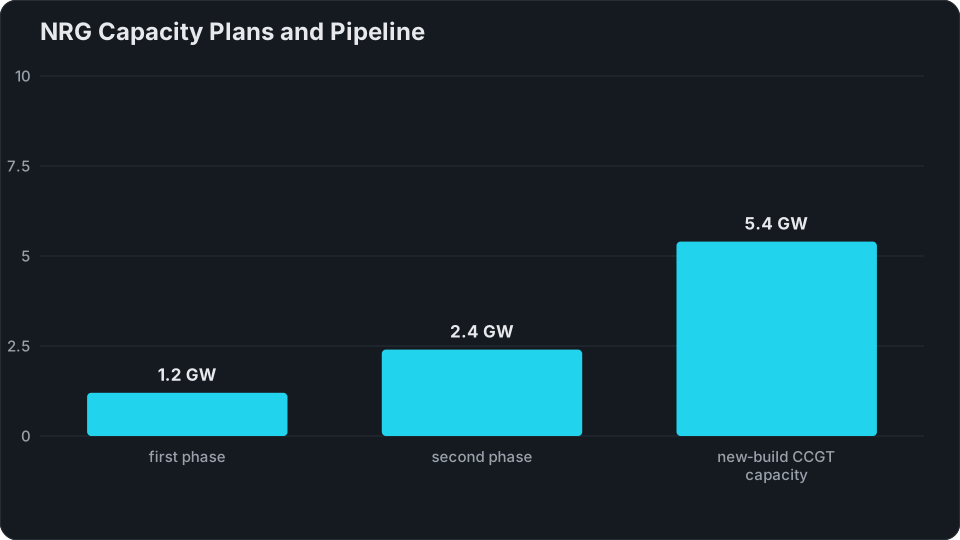
- First‑phase capital spend is about US$3.2 billion (≈ US$2,670/kW); commissioning is targeted for late 2029, with a possible second phase that would double capacity to 2.4 GW.
- ERCOT paused Batch Zero classification in August 2026; its multi-month eligibility verification must be completed before the load receives final Batch Zero inclusion.
- Texas is tracking >438 GW of large‑load interconnection requests, ~90 % of which are data‑center projects. ERCOT expects a final transmission plan for the Batch Zero cohort in the fall of 2027 and most projects to be operational by 2030.
Project snapshot: 1.2 GW dedicated gas generation for a Texas data‑center
NRG is advancing a proposed 1.2 GW combined-cycle natural-gas plant to support a Texas data-center development. The proposed design pairs 1.2 GW of new dispatchable capacity with new data-center load, rather than drawing on existing grid resources. NRG said it expects the development to create well over 1,000 construction and operational jobs and will generate new tax receipts for local governments and school districts. The project was first disclosed on the company’s earnings call on August 4 2026.
ERCOT Batch Zero interconnection framework
ERCOT’s Batch Zero process groups all large‑load requests of 75 MW or larger into a single study to capture the cumulative demand impact. The Public Utility Commission of Texas approved the rules that enable ERCOT to start reviewing these requests on June 18 2026. Under the original schedule, Batch Zero applicants were to receive inclusion notices in August, and ERCOT planned to publish a final transmission plan for the batch in the fall of 2027.
Current ERCOT status for the NRG plant
The NRG project was conditionally included as a Studied Load; the associated large load must still satisfy ERCOT’s verification, study and interconnection requirements. In August 2026, ERCOT announced a pause on Batch Zero classification and any energisation of large computational loads until the verification audit is finished. ERCOT indicated the verification process will take several months and warned it could remove a project from Batch Zero if attestations are materially false or the project fails to respond to information requests.
Hyperscaler partnership and commercial structure
NRG disclosed that it is “aligned on principal commercial terms” with an unnamed global cloud and AI hyperscaler for the 1.2 GW plant. The agreement carries a minimum 15‑year term, includes a guarantee from the customer’s parent company, and more than 95 % of cash flow will be derived from capacity payments. CEO Robert Gaudette summed the model up: “We’re paid for the megawatts we build and make available, not for how much the data center runs.”
Timeline, cost and expansion potential
NRG aims to have the first phase operational by late 2029. NRG said additional Texas development opportunities could expand the relationship to as much as 2.4 GW. The initial 1.2 GW phase is budgeted at US$3.2 billion, which works out to roughly US$2,670 per kilowatt. To support this and other projects, NRG has 5.4 GW of new‑build CCGT capacity secured through 2032 via partnerships with GE Vernova and Kiewit.
ERCOT verification workstreams explained
ERCOT’s verification effort consists of two parallel audits:
- Batch Zero Audit – applies to any load ≥ 75 MW submitted for Batch Zero.
- Community Impact Audit – targets computational loads ≥ 25 MW, gathering data on grid and water usage, on‑site generation, public financial assistance and community impact. The Batch Zero verification determines whether a large load qualifies for final inclusion. The community-impact RFI is a separate information-gathering process.
Texas large‑load queue context
ERCOT is tracking more than 438 GW of large‑load interconnection requests, and nearly 90 % of that demand comes from data‑center projects. The Batch Zero framework was introduced to streamline reviews and protect grid reliability amid this surge. ERCOT data shows that the majority of projects are expected to be operational by 2030.
Implications for AI‑compute infrastructure investors
NRG has structured the proposed customer-backed capacity model to make cash flow less dependent on data-center utilization: the company says about 95% of project free cash flow would be supported by capacity payments, with fuel and operating costs recovered separately. That structure would reduce exposure to merchant power and natural-gas prices if the deal is finalized.
Bottom line
NRG’s proposed 1.2 GW natural-gas project remains conditionally included as a Studied Load in ERCOT’s Batch Zero process following the September 8, 2026 announcement. ERCOT expects its eligibility verification to take several months. If the project clears the remaining requirements and reaches a final investment decision, NRG targets late 2029 for commercial operation.
Project comparison table
| Item | Value | Source |
|---|---|---|
| Capacity (phase 1) | 1.2 GW | Source 1 (BIC Magazine) |
| Conditional Batch Zero entry date | Sep 8 2026 | Source 3 (ad‑hoc‑news) |
| Estimated capital cost (phase 1) | US$3.2 B (≈ $2,670/kW) | Source 2 (Utility Dive) |
| Expected commissioning | Late 2029 | Source 2 (Utility Dive) |
| Job creation estimate | >1,000 construction & operations jobs | Source 1 (BIC Magazine) |
| Potential relationship size | Up to 2.4 GW | Source 2 (Utility Dive) |
| New‑build CCGT pipeline (total) | 5.4 GW through 2032 | Source 2 (Utility Dive) |
| ERCOT Batch Zero pause | August 2026 | Source 4 (Baker Botts) |
| Verification timeline | Several months | Source 4 (Baker Botts) |
| Texas large‑load queue | >438 GW, ~90 % data centers | Source 5 (Utility Dive) |
| Batch Zero study size rule | ≥75 MW requests bundled together | Source 5 (Utility Dive) |
Sources
This article was researched and fact-checked against the following sources:
- NRG 1.2 GW Natural Gas Plant Conditionally Included in ERCOT Batch Zero for Texas Data Center - BIC Magazine (bicmagazine.com)
- NRG nears 1.2-GW hyperscaler deal amid Texas data center pause | Utility Dive (utilitydive.com)
- NRG Energy stock last trades at USD 97.81 on September 28, 2026 (ad-hoc-news.de)
- Texas Large Load Interconnection Update: ERCOT Batch Zero Pause and Verification Process | Thought Leadership | August 2026 | Baker Botts (bakerbotts.com)
- Texas, facing 438 GW queue, approves initial large-load interconnection process | Utility Dive (utilitydive.com)